New Podcast: Keeping Care Running During Cyber Outages


Listen to the informative podcast, featuring the President & CEO of ComplyAssistant Gerry Blass and DCHA’s Senior Director of Emergency Management Eddie Rizvi as they tag team to answer questions about cyber incidents, downtimes, prevention strategies, and the tangible and intangible costs of cyber outages.

DCHA is Hiring Executive Assistant to President & CEO and Liaison to the Board of Directors

Come work for an outstanding association and team at the Associazione ospedaliera del distretto di Columbia as Executive Assistant to the President & CEO and Liaison to the Board of Directors. The District of Columbia Hospital Association has, for almost 45 years, worked to advance the missions of the hospitals and health systems of the District of Columbia by promoting policies and initiatives that strengthen the system of care, preserve access and promote better health outcomes for the patients and communities they serve. The Executive Assistant provides high-level administrative support to the President and CEO of the DC Hospital Association and serves as the key staff liaison to the DCHA Board of Directors. The Executive Assistant is responsible for managing the Executive office’s daily operations, coordinating communications, assisting with Board planning and activities, and ensuring smooth organizational functions. The role requires exceptional organizational, communication, writing, and multitasking abilities.

See Job Description & Apply

Quality Showcase: Patient Safety & Quality Initiatives from DC Hospitals


Hospitals Showcase Patient Safety & Quality Programs

Patient safety is a top priority for health care organizations. A better patient safety environment is associated with a lower probability of significant complications and dramatically reduces medical errors and adverse events, improves patient outcomes and increases efficiency and effectiveness. A patient safety culture within hospitals contribute to a higher standard of care, encourages collaboration and open communications, more coordinated care and improved overall performance. The showcase features 18 best practice programs that address patient safety and quality at D.C. hospitals, which illustrates their commitment to fostering a patient safety culture.

Download Quality Showcase

September 2025 Utilization Report


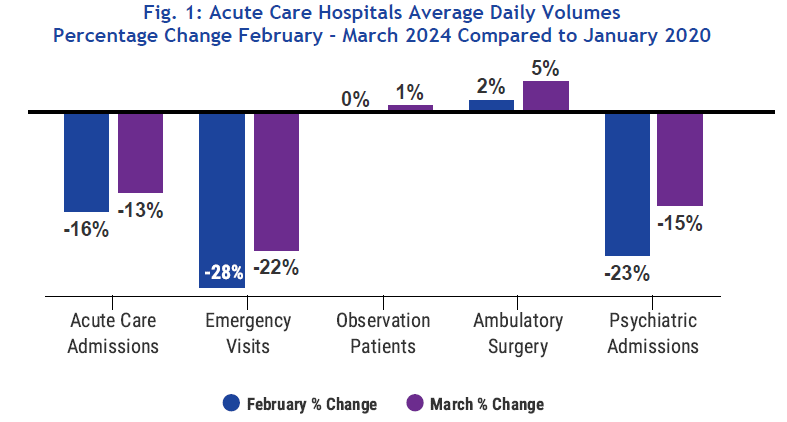
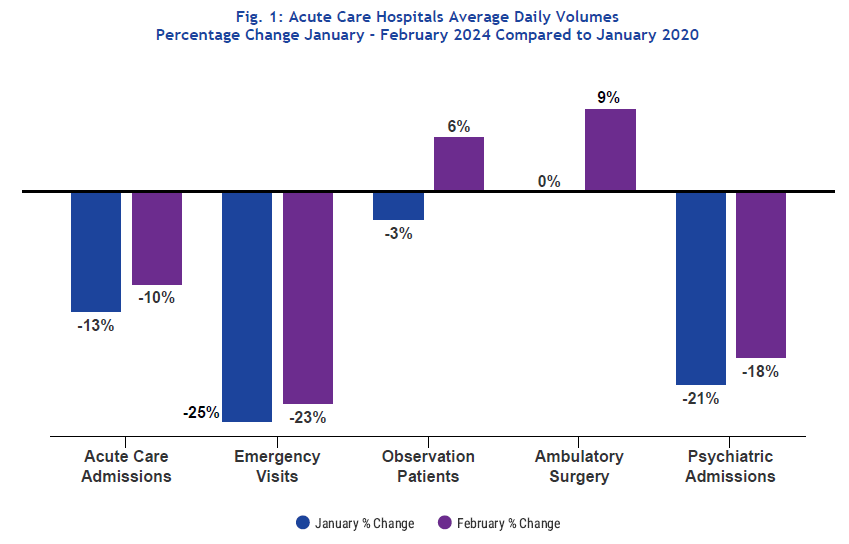
Highlights: Fig.1 below outlines the percentage change in monthly volumes for DC hospitals from August to September 2025 compared to a January 2020 pre-COVID baseline. This month all metrics show an increase in volumes compared to last month: observation admissions show the biggest improvement going from -8% below baseline in August to 2% over baseline in September, followed by emergency department visits showing an increase going from -27% in August to -21% in September. Psychiatric admissions went up from -22% below baseline last month to -18% this month, and acute care admissions and ambulatory surgery volumes show the smallest increase in number going from -14% in August to -13% in September, and -4% to -3% respectively.


Download Report

Top 10 Concerns in AI + Cybersecurity for Health Care


Health care leaders face mounting pressure to adopt AI while managing escalating cybersecurity risks. The guide identifies the critical challenges your organization needs to address—from AI-powered attacks and data privacy compliance to regulatory uncertainty, vendor risk, and resource constraints. This practical resource provides a 2025 urgency map to help you prioritize investments and build cross-functional governance. Learn how to position cybersecurity and AI risk management as enablers of safe innovation, not obstacles to it. Download the guide to assess your organization’s readiness and develop a strategic approach to AI adoption in health care.

Download Top 10 Concerns

2025 Vincent C. Gray Health Equity Award Winners

DCHA believes that to achieve health equity we must understand the challenges, aspirations, barriers, and realities of the community. It’s vital to share examples of innovative approaches to equity and shine a light on leaders across the District of Columbia. DCHA recognizes the importance of health equity and is working with its member hospitals to ensure that disparities in health care quality and access are eliminated.

In 2023, DCHA announced the Health Equity Award to honor and recognize those who are making health equity a reality in their community and leveraging engagement to improve health outcomes for those most impacted by health disparities.

The inaugural award was given to Vincent C. Gray for his demonstrated success in changing systems that impact health outcomes in access and equity, diversity, and inclusion. The award was given to recognize his decades of service to the District, history of dedication to eradicating health disparities, perseverance in ensuring that all residents have access to quality health care, and for being an instrumental force in making the Cedar Hill Regional Medical Center GW Health a reality.

The award is now called the Vincent C. Gray Health Equity Award to forever honor Vincent Gray’s legacy of being a voice for the voiceless and ensuring that health care is a right and not a privilege.

DCHA is proud and excited to name this year’s recipients of the 2025 Vincent C. Gray Health Equity Award for their commitment, dedication and inspiring actions to advance health equity and eliminate health disparities.

Nancy Mellon, Founder and Head of School for the River School
Nancy Mellon is a fierce champion for equity. In 2023, she launched the Community Outreach Fund to eliminate barriers to early diagnosis and care for children most at risk of falling through the cracks. In the U.S., about 25% of babies who fail their initial hearing screening do not receive follow-up care. In the District, that number is a shocking 80%. Studies have attributed this to the lack of access to and the high cost of care in underserved communities, long wait times, logistical difficulties and problems with insurance coverage or reimbursement. The Fund breaks down these barriers by offering no-cost speech-language/ hearing screenings and diagnostic testing to children in the community. Nancy Mellon is more than a visionary — she’s a leader, advocate, and change-maker whose work has reshaped education and care for children with hearing loss. Nancy has created a national model where education, diagnostics, intervention, advocacy and equity come together to give every child a voice.

Adrian Jordan, President, Wellpoint District of Columbia
Under Adrian’s leadership Wellpoint DC exemplifies a powerful commitment to advancing health equity by embedding health-related social needs into its core strategy. Through intentional community engagement, provider collaboration, and data-driven program design, Wellpoint DC is transforming the health landscape for District residents disproportionately impacted by health disparities. Its approach ensures that equity is not a separate goal—it is the foundation of how care is delivered, measured, and improved. At the heart of Wellpoint DC’s success is its local engagement model. The team partners with trusted Certified Business Enterprises and Community Based Organizations to enhance resource access and build trust. Wellpoint DC meets members where they live—offering education, connection, and empowerment.

Dr. Christopher J. King, Dean, School of Health, Georgetown University
Dr. King is a visionary leader and tireless champion for health equity — both in his professional work and in his personal mission. He is a respected leader, educator, advocate, author, and mentor whose influence continues to shape the future of equitable health care. Dr. King played a pivotal role in creating the DCHA Building Healthy Communities Committee and co-led the creation of a groundbreaking conceptual framework that empowers hospitals to embrace and overcome the challenge of ensuring equal access to care for all. His commitment, intellect, and compassion remind us that achieving health equity is not just a professional goal — it’s a moral imperative.

Food & Friends
Since its’ founding in 1988, Food & Friends has been tackling health equity through nutrition and food access by providing medically tailored meals for individuals living with serious or chronic illnesses. Over the last several years, Food & Friends has advanced a systems change model that embeds food as medicine within health care delivery. Through partnerships with health care providers, insurers, and hospital systems, Food & Friends helps patients with complex health needs stabilize the progression of their illness, improve health outcomes, reduce hospitalizations, and save on health care costs. A new independent evaluation confirms what Food & Friends has long known: meals tailored to a person’s medical needs can transform health outcomes, increase patient satisfaction, reduce hospitalizations, and lower cost of care.

Infinite Legacy
Infinite Legacy is the nonprofit organ procurement organization that serves 10 million people in the DMV region. The team facilitates organ, eye and tissue donation and works with hospitals and transplant centers to decrease the number of people waiting for a lifesaving transplant. Their health equity projects and the disparities they address are trifold: First, they educate Washingtonians about the critical importance of registering to be an organ donor. Nearly 4,000 people in our region are waiting for a lifesaving organ transplant and 64% of them are from multicultural communities. Second, Infinite Legacy focuses on providing communities with education about disease prevention and how to lead healthy lifestyles. And lastly, they provide a STEM curriculum to middle school students so they can learn about disease prevention, how to keep their organs healthy, what being an organ donor means and inspire them to consider careers in the field.

Centro ospedaliero MedStar Washington
Transitional Care Coordinator and Community Health Advocate Program

Every year, MWHC cares for more than 40,000 patients with complex medical and social needs. The team supporting these patients beyond the bedside are three transitional care coordinators and five community health advocates. Despite their small numbers, their impact is large. They built trust with patients and communities by helping to connect them with the support and resources they need to heal and thrive. Through their commitment and coordinated effort, the team achieved significant outcomes for patients, including a 40% reduction in hospital readmission and a 25.6% decrease in emergency department utilization, thereby improving the lives of our patients. Thanks to their dedication, MedStar is not just treating illness but helping people rebuild their lives. This program goes beyond the health issues patients face, rather, it supports the community by helping them navigate challenges like housing, food, and other critical needs.

Thank you to our Vincent C. Gray Health Equity Award sponsors: CareFirst BlueCross BlueShield, Howard University Hospital, Cedar Hill Regional Medical Center GW Health, AmeriHealth Caritas DC, Food & Friends, Georgetown Public Affairs, Infinite Legacy, Sibley Memorial Hospital, Wellpoint District of Columbia and in memory of Edward W. Webster, MD.

DCHA Announces 2025 Patient Safety & Quality Improvement Award Winners

The District of Columbia Hospital Association (DCHA) awarded its 2025 Patient Safety & Quality Improvement Awards at its Health Care & Innovation Summit on October 22 at the American University Washington College of Law in D.C. The award winners were chosen by a panel of independent judges from the health care industry.

“Thank you to everyone who participated in this year’s competition and congratulations to all of the award winners. We are so proud of the work you do to support your hospital and to promote patient safety and quality across the District,” said DCHA President & CEO Jacqueline D. Bowens.

The Patient Safety & Quality Improvement Competition award winners are: 

Gold: The George Washington University Hospital, Jaclyn Phillips, MD ($750)
Smarter Stages, Safer Birth: Targeted Strategies for Reducing Obstetric Hemorrhage
The George Washington University Hospital implemented a quality improvement initiative to reduce its high obstetric hemorrhage (OBH) rate by using standardized risk assessments, real-time blood loss tracking, and a stage-based management checklist. As a result, the OBH rate dropped from 15% to 13%, with severe hemorrhage reduced by 46%, and earlier use of medications and devices improved clinical response.

Silver: MedStar Washington Hospital Center, Stephanie Jerome, RN ($500)
ONE TEAM for VTE: Advancing Venous Thromboembolism Prevention Through Innovation and Collaboration
MedStar Washington Hospital Center launched a multidisciplinary initiative in mid-2024 to address a rising VTE rate focused on prevention through data-driven strategies, education, and improved clinical workflows. The project incorporated real-time analytics, patient engagement, and enhanced documentation, leading to a 39.1% reduction in VTE rates and placing the hospital in the top 10% nationally.

Bronze: MedStar Georgetown University Hospital, Harriet Kusi, PharmD ($250)
Right Route, Right Time: Leveraging Pyxis Alerts to Prevent Administration Errors
MedStar Georgetown University Hospital identified 11 safety events where intramuscular or subcutaneous medications were mistakenly administered intravenously, with trimethobenzamide and dicyclomine being most affected. To address this, the team implemented real-time Pyxis alerts warning staff of route-specific restrictions, developed through interdisciplinary collaboration. In the six months following implementation, no further wrong-route events occurred, demonstrating the effectiveness of targeted alerts and prompting plans to expand the strategy to other high-risk medications.

DCHA also awarded its 2025 Health Care & Innovation Individual Awards to individuals who exhibit excellence in their field, strengthening their hospital’s mission and goals. Award winners also manage change in an environment of competing priorities, and support resiliency and engagement from patients, caregivers, and the care team.

The Patient Safety & Quality Improvement Individual award winners are: 

Kathy Ibay, MSN, RN, Nurse Educator, MedStar Washington Hospital Center
Kathy was nominated because of her visionary leadership in guiding MedStar Washington Hospital Center to its first-ever Magnet designation in 2025. As Magnet Program Director, she transformed the pursuit of Magnet from a long-standing aspiration into a hospital-wide movement that redefined nursing culture.

Sydney Meszaros, Children’s National Hospital
Sydney was nominated for her exceptional leadership in advancing substance use prevention and intervention in the pediatric emergency department. Through her dedication, she has strengthened the hospital’s mission to address disparities, promote preventive care, and deliver innovative solutions that transform outcomes for vulnerable children and families.

“Congratulations to our winners! Your dedication to creating a safe patient care environment is a true embodiment of what hospitals stand for,” said DCHA President & CEO Jacqueline D. Bowens.

August 2025 Utilization Report


Highlights: Fig. 1 below outlines the percentage change in monthly volumes for DC hospitals from July to August 2025 compared to a January 2020 pre-COVID baseline. All metrics show a decrease in volumes this month with the exception of observation admissions which went from -13% below baseline in July to -8% in August, and acute care admissions remained constant at -14% this month. Psychiatric admissions and ambulatory surgeries declined going from -19% to -22%, and 4% over baseline to -4% respectively. Emergency department visits also present a slight decline in volumes this month going from -26% below baseline last month to -27% in August.


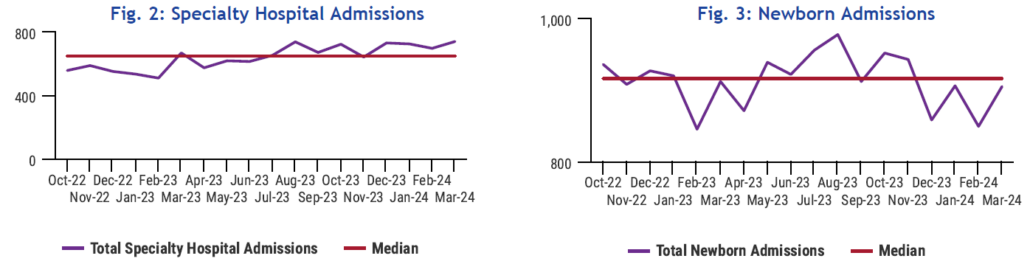
Specialty hospitals admissions present a statistical shift this month as they remain over the median for the sixth consecutive month as depicted in Fig. 2 below.


Download Report

July 2025 Utilization Report

Highlights: A look at Fig. 1 below outlines the percentage change in average daily volumes for DC hospitals from June to July 2025 compared to a January 2020 pre-COVID baseline. Acute care admissions declined, moving from -10% below baseline in June to -15% in July. Although there was a slight increase in emergency visits this month, they steadily remain below pre-pandemic levels at -24% in July. Observation patient volumes decreased slightly, falling from -8% below baseline in June to -10% in July. Ambulatory surgery volumes continue to show recovery to the baseline, though an increase from 1% above baseline in June to 7% in July was observed. Psychiatric admissions show a minor increase in volumes this month going from -20% below pre-COVID baseline in June to -16% in July.


Download Report

June 2025 Utilization Report

Highlights: A look at Fig. 1 below outlines the percentage change in average daily volumes for DC hospitals from May to June 2025 compared to the January 2020 baseline. Acute care admissions showed a slight improvement, moving from -14% below baseline in May to -10% in June. Emergency visits, while still reflecting the steepest declines, improved from -37% in May to -24% in June. Observation patient visits decreased in June, shifting from a 2% increase in May to -8% below baseline in June. Ambulatory surgery volumes remained relatively stable, with no difference from baseline in May and a 1% difference in June. Psychiatric admissions also showed a small change, moving from -22% in May to -20% in June compared to baseline. Newborn and neonatal admissions also present their lowest volumes in the past 15-month period displayed in the report in Tables 12 and 14. Also of note, with the the closure of United Medical Center and the opening of Cedar Hill Regional Medical Center GW Health in April 2025, data in the occupancy graphs show the reduction in census at United Medical Center and the corresponding increases in volumes at Cedar Hill.


Download Report
© 2026. District of Columbia Hospital Association.