DCHA Announces 2025 Patient Safety & Quality Improvement Award Winners

The District of Columbia Hospital Association (DCHA) awarded its 2025 Patient Safety & Quality Improvement Awards at its Health Care & Innovation Summit on October 22 at the American University Washington College of Law in D.C. The award winners were chosen by a panel of independent judges from the health care industry.

“Thank you to everyone who participated in this year’s competition and congratulations to all of the award winners. We are so proud of the work you do to support your hospital and to promote patient safety and quality across the District,” said DCHA President & CEO Jacqueline D. Bowens.

The Patient Safety & Quality Improvement Competition award winners are: 

Gold: The George Washington University Hospital, Jaclyn Phillips, MD ($750)
Smarter Stages, Safer Birth: Targeted Strategies for Reducing Obstetric Hemorrhage
The George Washington University Hospital implemented a quality improvement initiative to reduce its high obstetric hemorrhage (OBH) rate by using standardized risk assessments, real-time blood loss tracking, and a stage-based management checklist. As a result, the OBH rate dropped from 15% to 13%, with severe hemorrhage reduced by 46%, and earlier use of medications and devices improved clinical response.

Silver: MedStar Washington Hospital Center, Stephanie Jerome, RN ($500)
ONE TEAM for VTE: Advancing Venous Thromboembolism Prevention Through Innovation and Collaboration
MedStar Washington Hospital Center launched a multidisciplinary initiative in mid-2024 to address a rising VTE rate focused on prevention through data-driven strategies, education, and improved clinical workflows. The project incorporated real-time analytics, patient engagement, and enhanced documentation, leading to a 39.1% reduction in VTE rates and placing the hospital in the top 10% nationally.

Bronze: MedStar Georgetown University Hospital, Harriet Kusi, PharmD ($250)
Right Route, Right Time: Leveraging Pyxis Alerts to Prevent Administration Errors
MedStar Georgetown University Hospital identified 11 safety events where intramuscular or subcutaneous medications were mistakenly administered intravenously, with trimethobenzamide and dicyclomine being most affected. To address this, the team implemented real-time Pyxis alerts warning staff of route-specific restrictions, developed through interdisciplinary collaboration. In the six months following implementation, no further wrong-route events occurred, demonstrating the effectiveness of targeted alerts and prompting plans to expand the strategy to other high-risk medications.

DCHA also awarded its 2025 Health Care & Innovation Individual Awards to individuals who exhibit excellence in their field, strengthening their hospital’s mission and goals. Award winners also manage change in an environment of competing priorities, and support resiliency and engagement from patients, caregivers, and the care team.

The Patient Safety & Quality Improvement Individual award winners are: 

Kathy Ibay, MSN, RN, Nurse Educator, MedStar Washington Hospital Center
Kathy was nominated because of her visionary leadership in guiding MedStar Washington Hospital Center to its first-ever Magnet designation in 2025. As Magnet Program Director, she transformed the pursuit of Magnet from a long-standing aspiration into a hospital-wide movement that redefined nursing culture.

Sydney Meszaros, Children’s National Hospital
Sydney was nominated for her exceptional leadership in advancing substance use prevention and intervention in the pediatric emergency department. Through her dedication, she has strengthened the hospital’s mission to address disparities, promote preventive care, and deliver innovative solutions that transform outcomes for vulnerable children and families.

“Congratulations to our winners! Your dedication to creating a safe patient care environment is a true embodiment of what hospitals stand for,” said DCHA President & CEO Jacqueline D. Bowens.

August 2025 Utilization Report


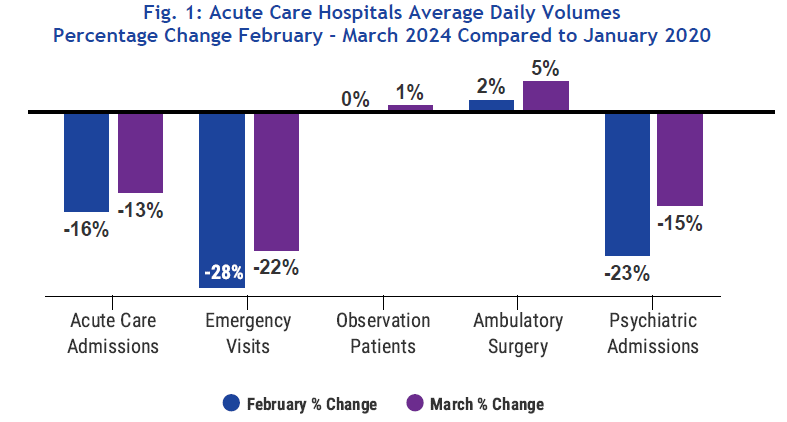
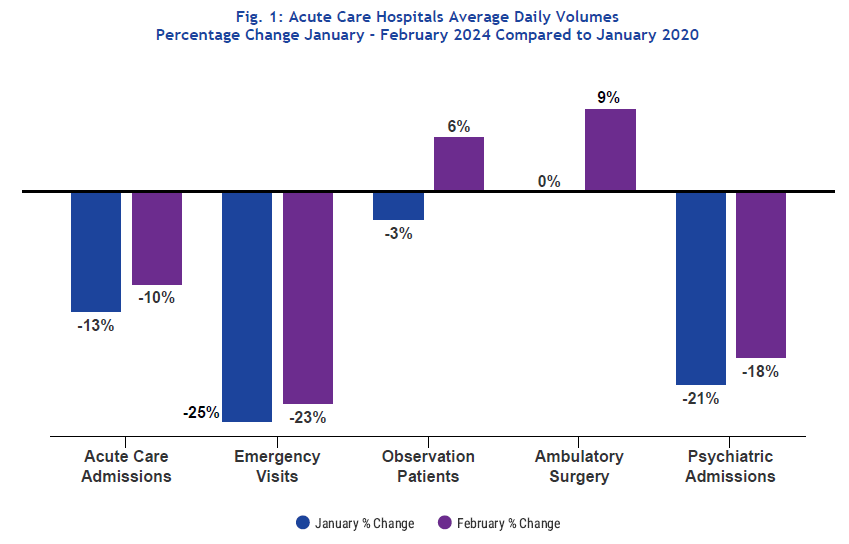
Highlights: Fig. 1 below outlines the percentage change in monthly volumes for DC hospitals from July to August 2025 compared to a January 2020 pre-COVID baseline. All metrics show a decrease in volumes this month with the exception of observation admissions which went from -13% below baseline in July to -8% in August, and acute care admissions remained constant at -14% this month. Psychiatric admissions and ambulatory surgeries declined going from -19% to -22%, and 4% over baseline to -4% respectively. Emergency department visits also present a slight decline in volumes this month going from -26% below baseline last month to -27% in August.


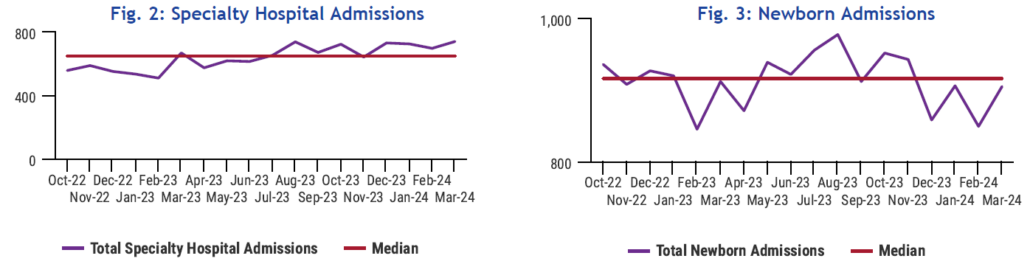
Specialty hospitals admissions present a statistical shift this month as they remain over the median for the sixth consecutive month as depicted in Fig. 2 below.


Download Report

July 2025 Utilization Report

Highlights: A look at Fig. 1 below outlines the percentage change in average daily volumes for DC hospitals from June to July 2025 compared to a January 2020 pre-COVID baseline. Acute care admissions declined, moving from -10% below baseline in June to -15% in July. Although there was a slight increase in emergency visits this month, they steadily remain below pre-pandemic levels at -24% in July. Observation patient volumes decreased slightly, falling from -8% below baseline in June to -10% in July. Ambulatory surgery volumes continue to show recovery to the baseline, though an increase from 1% above baseline in June to 7% in July was observed. Psychiatric admissions show a minor increase in volumes this month going from -20% below pre-COVID baseline in June to -16% in July.


Download Report

June 2025 Utilization Report

Highlights: A look at Fig. 1 below outlines the percentage change in average daily volumes for DC hospitals from May to June 2025 compared to the January 2020 baseline. Acute care admissions showed a slight improvement, moving from -14% below baseline in May to -10% in June. Emergency visits, while still reflecting the steepest declines, improved from -37% in May to -24% in June. Observation patient visits decreased in June, shifting from a 2% increase in May to -8% below baseline in June. Ambulatory surgery volumes remained relatively stable, with no difference from baseline in May and a 1% difference in June. Psychiatric admissions also showed a small change, moving from -22% in May to -20% in June compared to baseline. Newborn and neonatal admissions also present their lowest volumes in the past 15-month period displayed in the report in Tables 12 and 14. Also of note, with the the closure of United Medical Center and the opening of Cedar Hill Regional Medical Center GW Health in April 2025, data in the occupancy graphs show the reduction in census at United Medical Center and the corresponding increases in volumes at Cedar Hill.


Download Report

Vincent C. Gray Health Equity Award Call for Nominations

DCHA believes that to achieve health equity we must understand the challenges, aspirations, barriers, and realities of the community. To share the example of innovative approaches to equity and shine a light on leaders across the District of Columbia, DCHA created the Vincent C. Gray Health Equity Award. DCHA recognizes the importance of health equity and is working with its member hospitals to ensure that disparities in health care quality and access are eliminated. The award is to honor and recognize individuals and organizations who are making health equity a reality in their community and leveraging engagement to improve health outcomes for those most impacted by health disparities. The award will go to an individual or organization that can demonstrate they have contributed to reducing disparities in health care quality. Nominations are due October 13, 2025.

Award Criteria:

  • Nominations must show demonstrated success in changing systems that impact health outcomes for the DC community.
  • Nominations must demonstrate a successful implementation of a systems change approach to addressing gaps in care and outcomes within the past five years.
  • Ability to show others how to reduce disparities in quality, access, and outcomes.

DCHA will assess each application through a competitive process to identify the individual/organization that has had the greatest impact on health equity.

Start a Nomination


Cedar Hill Releases 45-Day Community Impact Report


Cedar Hill Regional Medical Center GW Health (CHRMC) shared its 45-Day Community Impact Report — a snapshot of the lives impacted since opening their doors. The report highlights the lives touched, the care delivered, and the promise to keep for Washingtonians, especially for communities in Wards 7 and 8. This report reflects the heart and hard work of Cedar Hill providers, staff, and community partners. In the first 45 days, the emergency department (ED) saw 5,323 patient visits — including 4,006 adult and 1,317 pediatric visits. That’s more than double the average daily ED volume previously seen at United Medical Center. It confirms the demand for quality health care in this region is deep and urgent. While the ED team rose to meet this demand, data revealed a concerning reality: 80 percent of the ED visits could have been treated in a primary or urgent care setting. This reinforces the urgent need for expanded access to preventive and routine care — access that is on the way as CHRMC will open new primary care, OB/GYN, and dialysis clinics to fill this critical gap.

Download Community Impact Report

DCHA is Hiring a Project Coordinator

The District of Columbia Hospital Association has, for more than 45 years, worked to advance the missions of the hospitals and health systems of the District of Columbia by promoting policies and initiatives that strengthen the system of care, preserve access and promote better health outcomes for the patients and communities they serve. The role of the Project Coordinator is to foster the work of the Association and the Association’s members through management of assigned projects, analytics and quality, and liaison activities in support of priorities for improvement and strategic goals. Responsibilities include:

  • Assist with coordination and administration of hospital workgroups and other collaborations.
  • Collaborate with assigned project team members to develop work plan and project timelines and implement deliverables.
  • Assist with work plan and timeline monitoring to identify when interventions are necessary to facilitate adherence to project deliverables and collaborate with team members to execute interventions.
  • Responsible to learn and manage various software used by the Association for assigned project data management and reporting.
  • Facilitate successful data collection and reporting to support evaluation of project deliverables and outcomes.
  • Provide staff support on activities for assigned projects in partnership with colleagues and stakeholders.
  • Assist other professional staff in the performance of assigned duties and responsibilities to enable achievement of assigned project goals.
  • Work with colleagues to establish relationships to enable successful execution and completion of assigned projects.
  • Provide research, writing and related input for formulation and development of program evaluations.
  • Utilize quality improvement strategies to support the successful implementation of project goals and deliverables.
See Job Description & Apply

Howard University Hospital & Sibley Memorial Hospital Community Health Needs Assessment

A Community Health Needs Assessment (CHNA) helps health leaders evaluate the health and wellness of the community they serve and identify gaps and challenges that should be addressed through new programs, services and policy changes. This CHNA is the product of a six-month process led by a Steering Committee with input from multiple individuals, organizations, and groups. The Steering Committee for this process was comprised of staff from Sibley Memorial Hospital and Howard University Hospital. These individuals were integral in making this comprehensive assessment possible.

Download Community Health Needs Assessment

Partnering With The Community: Best Practices For Equitable Clinical Research

MedStar Health’s Safe Babies Safe Moms Program (SBSM) has demonstrated success in helping to turn the tide against maternal mortality in Washington, DC. This program’s foundational research was centered on the lived experiences of community members.

Despite progress, maternal health remains a crisis in the U.S. with Black patients who give birth are more than three times more likely than their white counterparts to die from causes related to pregnancy.  

The maternal mortality rate is higher in the U.S. than in any other developed nation, and the problem is worse for Black women. According to 2023 data from the Centers for Disease Control and Prevention, Black mothers die at a rate nearly three-and-a-half times higher than their White and Hispanic counterparts, and almost five times that of Asian American birthing individuals.

Severe maternal morbidity, including cardiovascular conditionsdiabetes, bleeding, anemia, depression, and anxiety, follows similar trends. A retrospective study found Black birthing individuals have a 70% greater risk of these outcomes related to pregnancy than their White counterparts. 

Studies have shown that about 80% of pregnancy-related deaths and 90% of maternal morbidities can be prevented. To help understand more about how and why these disparities exist and stubbornly remain, it’s essential to consider both the numbers and the narratives behind Black mothers’ experiences.

Full Story

May 2025 Utilization Report


Destaques: A look at Fig. 1 below outlines the changes in our focus metrics, all presenting a decline in volumes this month. Observation admissions declined compared to 2020 pre-COVID baseline from 10% in April to 2% in May. Psychiatric admissions showed the same decreasing pattern going from -21% below baseline in April to -22% in May. Emergency department visits and acute care admissions also show a decline in volumes going from -23% and -13% below baseline in April to -39% and -25% in May respectively. Ambulatory surgeries showed a decrease in volumes, going from 7% to 0% over baseline from last month to the current month. Newborn and neonatal admissions also present their lowest volumes in the past 15-month period displayed in the report as depicted in Tables 12 and 14. With the closure of United Medical Center (UMC) and opening of Cedar Hill Regional Medical Center GW Health in April 2025, data in the occupancy graphs shows the reduction in census at UMC and the corresponding increases in volumes at Cedar Hill. Although the influx of ED volumes began and remained high, the occupancy graphs at the end of the report show a slower ramp up for other services at Cedar Hill (see Average Daily Census by Hospital and Service graphs starting on page 13).


Download Report
© 2025. District of Columbia Hospital Association.