Top 10 De-Escalation Tips for Health Care Professionals

Every day at the workplace presents new encounters, situations, and challenges for the health care professional. You may find yourself dealing with angry, hostile, or noncompliant behavior every day. Your response to this defensive behavior plays a critical role in determining whether or not the incident will escalate into a crisis situation. These 10 de-escalation tips provide strategies and techniques to help you respond to difficult behavior in the safest, most effective way possible.

  1. Be empathetic and nonjudgmental
  2. Respect personal space
  3. Allow time for decisions
  4. Use nonthreatening nonverbals
  5. Set limits
  6. Focus on feelings
  7. Ignore challenging questions
  8. Avoid overreacting
  9. Choose what you insist upon wisely
  10. Allow silence for reflection

DeEscalation Tips for Health Care

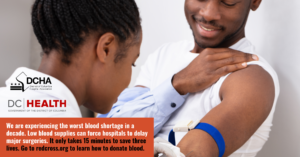
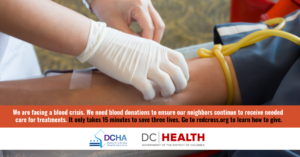
Donate Blood – The Red Cross is Experiencing the Worst Blood Shortage in a Decade

The Red Cross is experiencing the worst blood shortage in over a decade. Low blood supply levels can force hospitals to defer patients from major surgery. Blood donation is desperately needed.

General Messaging

  • The current blood crisis is the worst in the past 10+ years.
  • The Red Cross continues to have a need for blood donations to ensure hospital patients in our community continue to receive needed care for treatments, such as transfusions for those battling cancer. All blood types are needed, especially types O+ & O-.
  • Please head to RedCrossBlood.org to find the next available appointment to donate.
  • The Red Cross, which supplies 40% of the nation’s blood supply, has had to limit blood product distributions to hospitals as a result of the shortage. In fact, some hospitals may not receive 1 in 4 blood products they need.
  • Blood cannot be manufactured or stockpiled and can only be made available through the kindness of volunteer donors.
  • You can save three lives in 15 minutes.

What is Causing the Blood Shortage Crisis?

  • Overall blood donations have declined by 10% since March 2020.
  • There has been a 62% drop in college and high school blood drives due to the pandemic. Student donors accounted for ~25% of donors in 2019 accounted for just ~10% during the pandemic.
  • There are ongoing blood drive cancellations due to illness, weather-related closures and staffing limitations.

Critically Needed Blood

  • Type O positive is the most transfused blood type and can be transfused to Rh-positive patients of any blood type. 38% of the population has O positive blood, making it the most common type.
  • Type O negative is the universal blood type and what emergency room personnel reach for when there is no time to determine the blood type of patients in the most serious situations.
  • Platelets are the clotting portion of blood, which must be transfused within five days of donation.
    • Nearly half of all platelet donations are given to patients undergoing cancer treatments

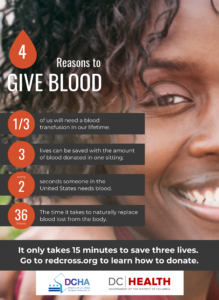
Reasons to Give Blood

  1. 1/3 of us will need a blood transfusion in the future
  2. 3 lives can be saved with the amount of blood donated in one sitting
  3. Every two seconds someone in the United States needs blood
  4. 36 hours is the time it takes to naturally replace blood lost from the body

Call to Action

  • Make sure people know where and how to donate blood.
  • Go to redcross.org to learn how to give.

Sources: American Red Cross, Give Blood, One Blood

Sample Graphics


The Joint Commission Releases Requirements for COVID Vaccination of Health Care Personnel

On February 16, 2022, The Joint Commission shared required documentation for COVID vaccination among health care staff.  The Joint Commission will now be requiring health care facilities to provide the following documentation:

  1. Overall COVID vaccination rate of eligible staff
  2. A list of all staff, including positions/titles, including COVID vaccination status
  3. All policies regarding health care staff COVID vaccinations
    • Policies for COVID vaccination exemptions
    • Policies for COVID vaccination requirements
    • Policies for mitigation of unvaccinated staff
  4. List of newly hired staff in last 60 days

New Requirements

  • A process for tracking and securely documenting the COVID-19 vaccination status of all staff.
  • A process for tracking and securely documenting the COVID-19 vaccination status of any staff who have obtained any booster doses as recommended by the CDC.
  • A process by which staff may request an exemption from the staff COVID-19 vaccination requirements based on an applicable federal law.
  • A process for tracking and securely documenting information provided by those staff who have requested, and for whom the organization has granted, an exemption from the staff COVID-19 vaccination requirements based on recognized clinical contraindications or applicable federal laws.
    • Surveyors will not assess the appropriateness of clinical contraindications or religious exemptions.
  • A process for ensuring that all documentation that confirms recognized clinical contraindications to COVID-19 vaccines and supports staff requests for medical exemptions from vaccination has been signed and dated by a licensed practitioner who is not the individual requesting the exemption, and who is acting within their respective scope of practice as defined by, and in accordance with, all applicable state and local laws. Such documentation contains:
    • All information specifying which of the authorized COVID-19 vaccines are clinically contraindicated for the staff member to receive the recognized clinical reasons for the contraindications.
    • A statement by the authenticating practitioner recommending that the staff member be exempted from the organization’s COVID-19 vaccination requirements for staff based on the recognized clinical contraindications.
    • Surveyors only evaluate that the documentation is complete; they do not assess the appropriateness of clinical contraindications or religious exemptions.

Vaccination Rate Calculation

  • Numerator Includes
    • Pending religious or medical exemption (during first 30 days of implementation)
    • Approved religious or medical exemption
    • Persons having an approved CDC temporary delay for vaccination
    • Persons with clinical contraindication to receiving COVID vaccine
    • Staff who have received at least one dose of a vaccine should be placed in the numerator of the calculation during first 30 days
  • Who Must be Vaccinated?
    • Facility employees
    • Licensed practitioners
    • Students
    • Trainees
    • Volunteers
    • Contracted staff
    • Staff who perform duties offsite (e.g., home health) and to individuals who enter CMS regulated facilities (i.e., a physician with privileges in a hospital who is admitting and/or treating patients onsite)
© 2026. District of Columbia Hospital Association.